
LiveWell Blog
Shannon Kiley, MMT, MT-BC
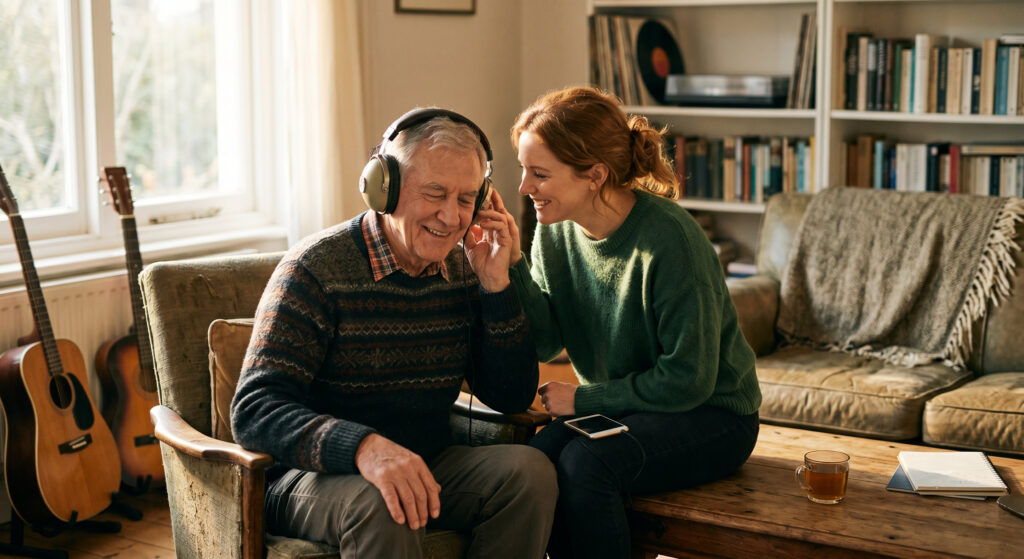
Music carries magic. And like anything that carries magic, there will always be some level of mystery involved. Why do some songs resonate so deeply? Why can music bring us into a greater sense of aliveness? Why does it connect us so well to each other? How does music advance engagement deep into a dementia diagnosis so well, when most other sensory input goes somewhere unseen?
Though the magic part of music will always be somewhat hidden, there is an awful lot about music that we can and do study to understand how it affects us, and how we can use it as a tool for greater well-being.
In my field of music therapy, a particular dimension of music is utilized intentionally to foster a desired outcome. A music therapist might use the words of a familiar song to help regain speech skills while working with a person who has suffered a stroke, for example, or they might use the structure of music to help a child with developmental disabilities to make a smoother transition into the next task. Sometimes it might be the words, the structure, the rhythm, the mood, or the reward of music itself that music therapists use to help clients reach their goals, but everyone can learn to use the various aspects of music to support their cognitive health and wellbeing. Let’s dive into it by focusing on three of the primary aspects of music we can use.
MOOD
Let’s begin by talking about using music to support mood. Music is a cost-effective and accessible way to alter our mood state, and we especially need the power of music in our corner to help us combat the negative impacts of stress. These impacts on cognitive health and many body systems are well-documented, and it is wise to reach for music first to help relieve stress quickly and effectively before reaching for a drink or for TV.
We instinctually lean on music’s emotional impact by using it to amplify a particular mood state. When we’re feeling good, we reach for the dance tunes to amplify and express this feeling. When we’re calm, we opt for soothing music.
When we want to change a mood state with music, however, we often assume that the same soothing music will help us when we’re upset. This may be the case, but often that music will not meet us where we’re at in that moment and can make us feel even more alone or angry. When looking to shift moods with music, music therapists will first choose music that matches the mood state the client is currently feeling before trying to change it. So, when we’re feeling angry, we might first need to turn up the high-energy music to help let the anger out; then we can begin to shift the music gradually to the soothing tunes, each song getting a bit closer to that “end goal” mood. Likewise, when we’re feeling sad, if we start by listening to music that validates that sad state, then our emotional states are more willing to come along with our brain when we slowly move into something more upbeat.
This method of first matching before shifting is called the “iso-principle” and is an oft-used tool in the music therapist’s tool belt. In a more general sense, this idea of “meet them where they are” (which is applicable to myriad situations from sales to education to healthcare) requires taking time to empathize first with where you or they are currently, before trying to change anything. I often give the example of the too-common experience of being told to “calm down” when angry; how often does that phrase actually help create calm?
The music iso-principle can be applied to much more than just mood: you can use it to shift many things from your energy levels, the pace of a workout, your heartbeat, or your relaxation before sleep. For example, to help keep pace during a workout, build a playlist for yourself that begins at the pace you’d like to start your workout, and gradually increase the tempo and energy throughout the playlist. Then, as your workout comes to a close, begin to stack songs toward the end that decrease in intensity to assist in your cool-down.
This principle works in tandem another rhythmic phenomenon called “entrainment”, which brings us into the realm of discussing rhythm as the second aspect of music which we can utilize for optimal brain and body wellbeing.
RHYTHM
First observed in 1665 by Christiaan Huygens, the inventor of the pendulum clock, entrainment happens when two oscillating systems interact with each other and then synchronize. He noticed that two pendulum clocks on same wall or beam would eventually synchronize their ticking through the lengthy exchange of microscopic vibrations. In nature, when two things are oscillating at a rhythm near each other, they tend to match up over time. Adjusting from jet lag, for instance, is a form of natural entrainment.
Entrainment with music can also help people who are working on walking; after suffering a stroke, many people must relearn walking, and the regular tempo of music can help the brain predict exactly how long the body has before taking the next step. This helps the brain coordinate movements between all the muscles involved in walking. Similarly, those with Parkinson’s who are working on keeping regularity in their walking pace can use music to help improve consistency in their steps.
We are rhythmic beings, and we live out many micro- and macro-rhythms every day. Our heart is always beating and our lungs are always breathing, to start. Our walking pace has a certain rhythm. Brushing our teeth has a rhythm. Our speech even has rhythm. On a larger scale, the rhythms of our daily habits, our days, weeks, seasons both calendar and emotional, and years all give shape to our lives.
We can lean on the rhythm of music for so many things: improving our sense of time, motor coordination, temporal planning, altering our energy level or alertness, or assisting in getting a dance party going!
WORDS
Music lyrics can help us in so many ways. We know that isolation is a risk factor for dementia and that lyrics can help us feel more connected to each other; lyrics lessen our sense of being alone in our struggles when we are going through a hard time; have you ever heard the right song at the right time that was able to speak directly to your situation? It feels like getting a hug from a friend when you really need it!
Because talking about the meaning of lyrics activates the frontal lobe of the brain involved in reasoning and decision-making, grab a friend to talk about your favorite lyrics to keep that brain area stimulated.
If you or a loved one has had a stroke, singing can help support speech therapy goals between sessions. Perhaps find a favorite song that includes targeted words or speech sounds and sing along, or set important phrases to a little melody to aid in retention.
Joining a choir can amplify these benefits; singing in a group can support our lung health, reduce stress, and even improve our immunity.
There are so many ways to use music to support brain health! The possibilities are endless.
Start a dance party in your kitchen. Crank the tunes when you need an energy boost. Join a local drum circle and shake a tambourine. Go see live music as much as you can. Brain scans of musicians regularly show an increase in connection between the two hemispheres of the brain; learning to play music is one of the best things we can do to support brain health. Choose any and all that appeal to you, make it a habit, and you will be on your way to a healthier brain and a more vibrant life.